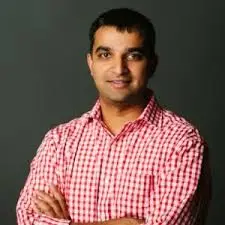
 The Executive

Ali Ghodsi
The Berkeley-trained distributed-systems researcher who co-created Apache Spark has led Databricks since 2016 and taken it to a $190 billion valuation.
Leading Databricks in the AI era
Ali Ghodsi is co-founder and chief executive of Databricks, the San Francisco data and AI company he helped start in 2013. Databricks describes itself as a data and AI company whose platform is built on an open lakehouse architecture, and says more than 20,000 organizations use it, including 70 percent of the Fortune 500 and customers such as Block, Comcast, Condé Nast, Rivian and Shell.[1]
On August 13, 2026, Databricks announced a $5 billion funding round at a $190 billion valuation, led by Coatue with Blackstone, MGX and T. Rowe Price-advised accounts. The Next Web reported that the company said its revenue run-rate had passed $7 billion, with growth above 80 percent year over year in the second quarter, and that it was adjusted free-cash-flow positive over the prior twelve months. The valuation was up from $134 billion in February, when the run-rate was reported at $5.4 billion. Run-rate is an annualized measure and flatters fast-growing companies, so these are company-reported figures, not audited results.[3][4]
From Iran to Sweden
Ghodsi was born in Iran in 1978. In an interview profile, he described his family leaving for Sweden in the mid-1980s during the Iran-Iraq war, settling after moving through student housing, and getting a broken Commodore 64 that started his interest in programming. These are his own recollections as reported by btw.media.[5]
He earned a master's degree in computer engineering and an MBA from Mid-Sweden University in 2002, and a PhD in distributed computing from KTH Royal Institute of Technology in 2006, advised by Seif Haridi. Databricks' own author page lists the MBA as 2003; the two accounts differ by a year.[2][5]
Peerialism, KTH and Berkeley
Before Berkeley, Ghodsi co-founded Peerialism, a Stockholm company developing peer-to-peer data transfer technology, and served as an assistant professor at KTH from 2008 to 2009.[5]
In 2009 he joined UC Berkeley as a visiting scholar, working with Scott Shenker, Ion Stoica, Michael Franklin and Matei Zaharia. In that group he helped start the Apache Mesos and Apache Spark projects and co-invented dominant resource fairness, a scheduling approach for sharing several kinds of computing resources among users. His bio says his research on resource scheduling and data caching has been applied in Mesos and Hadoop. He remains an adjunct professor at Berkeley and serves on the board of its RISELab.[2][5]
Founding and running Databricks
Databricks says it was founded in 2013 by the original creators of the lakehouse architecture and of the open-source projects Apache Spark, Delta Lake, MLflow and Unity Catalog. Ghodsi began as head of engineering and product and became chief executive in 2016.[1][5]
That makes his tenure the period in which Databricks grew from a Spark company into a broad data and AI platform. He has framed the current strategy around enterprise AI agents: The Next Web summarized his pitch as buyers wanting agents that keep context, stay accurate and manage budgets, rather than simple chatbots.[3]
Acquisitions and launches
His author page on the Databricks blog lists a run of announcements under his name, including the Einblick acquisition in January 2024, the DBRX open model in March 2024, the Tabular acquisition in June 2024, the open-sourcing of Unity Catalog the same month, SAP Databricks in February 2025, Neon in May 2025, full Apache Iceberg support and the Lakebase database concept in June 2025, general availability of Lakebase in February 2026, and a June 2026 post introducing an agentic customer data platform.[2]
TechTarget reported that Databricks agreed in May 2025 to acquire Neon, a Postgres database startup founded in 2021, for approximately $1 billion, and noted that MosaicML (June 2023) and Tabular were each valued at $1 billion or more. Analysts quoted there called Neon the most significant Databricks acquisition to date, and Databricks said agents created more than 80 percent of Neon databases.[6]
According to The Next Web, Databricks' data warehousing business had passed a $1.5 billion run-rate, Lakebase had passed $100 million, more than 1,000 accounts were spending at a $1 million run-rate and over 100 at $10 million.[3]
On going public
Ghodsi has resisted an IPO in 2026. The Next Web reported that he called it a bad year to list, pointing to SpaceX, OpenAI and Anthropic absorbing about $200 billion in listing capital, and that Databricks was raising at public-market scale while staying private. The report gives no listing date.[3]
Why he matters
Ghodsi sits at the junction of academic systems research and enterprise software. The Spark project he helped start became a standard tool for large-scale data processing, and Databricks has used that open-source base to build one of the most valuable private technology companies. His 2026 round, and the question of when and whether Databricks lists, make him one of the figures whose decisions will shape how enterprises buy data infrastructure for AI.[1][3]
On The Executive List
Ali Ghodsi is ranked No. 11 on The Executive List (October 2026) in the Chief Executive Officers discipline. The ranking reflects The Executive Review's own editorial Trending Score; it is not an outside award, and placement on the list is never sold. View the October 2026 edition.
Sources
- Databricks - About us
- Databricks Blog - Ali Ghodsi, author page
- The Next Web (Aug. 2026) - Databricks closes $5 billion round at $190 billion valuation
- W.Media - US$5 billion funding round pushes Databricks valuation to US$190 billion
- btw.media - Who is Ali Ghodsi, CEO of Databricks
- TechTarget (May 2025) - Databricks adds Postgres database with $1B Neon acquisition
Profile compiled from the public sources above by The Executive Review editors. Last updated 2026-10-23.